
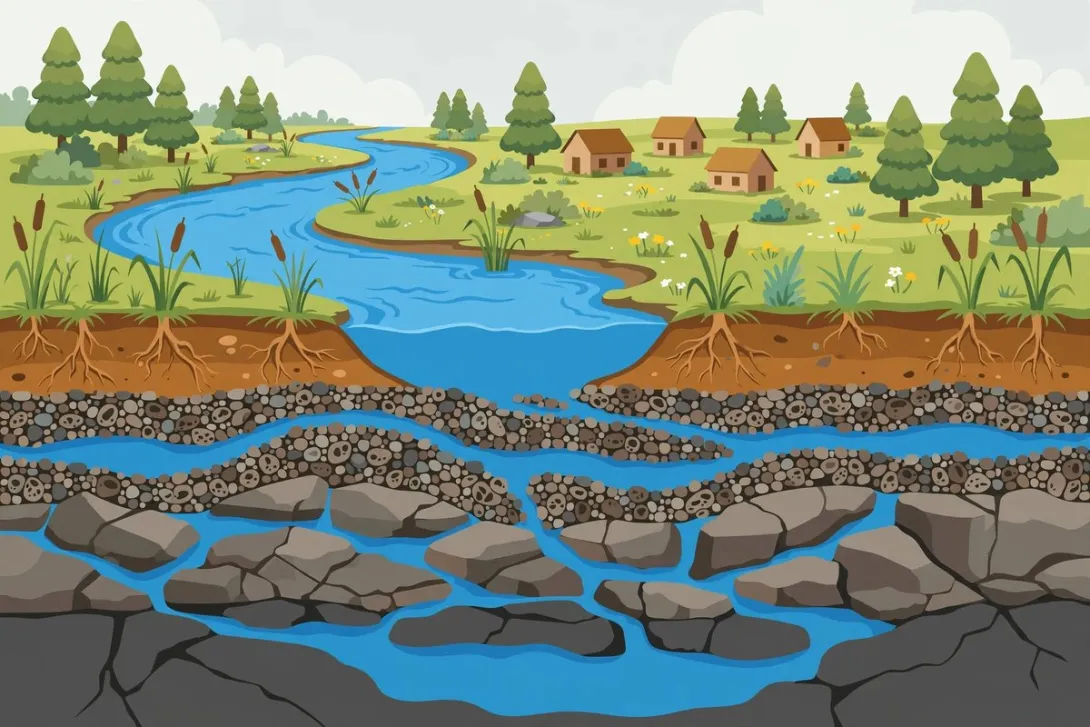
Every glass of water in Post Falls comes from beneath your feet. The Spokane Valley–Rathdrum Prairie Aquifer — a vast underground reservoir of water held in gravel, cobbles, and boulders — supplies drinking water to some 600,000 people across northern Idaho and northeastern Washington, including Post Falls' 20,000-plus residents.
The aquifer underlies about 370 square miles of relatively flat valley from Pend Oreille Lake to the western edge of Spokane. It was formed by the catastrophic Ice Age floods that repeatedly broke the ice dam holding back ancient Glacial Lake Missoula, washing coarse sediment across the prairie. Water moves through those gravels remarkably fast — and because the aquifer has no continuous protective layer above it, it is highly vulnerable to contamination.
In 1978, the U.S. Environmental Protection Agency designated the aquifer a Sole Source Aquifer, recognizing that the region has no viable alternative drinking water supply. The Idaho Department of Water Resources and Washington agencies manage the resource jointly, and Spokane County has monitored water quality at dozens of locations since 1977.
The science is mostly reassuring — a 20-year analysis found overall water quality excellent, with stable groundwater levels — but it also flagged rising chloride concentrations, a reminder that what happens on the surface ends up in the tap. Fast-growing cities like Post Falls, Coeur d'Alene, and Spokane sit directly atop their own water supply.
The City of Post Falls' own water resources page puts it plainly: we live and work above our drinking water. That makes aquifer protection a kitchen-table issue — from how we handle chemicals and stormwater to how the prairie develops. Residents can do their part by treating the ground like their glass of water: keeping paints, oils, and chemicals out of storm drains and off the soil, and supporting land-use decisions that keep the recharge area healthy.
The water beneath us is a shared inheritance — one that took Ice Age floods to build and could take far less to spoil. It takes care of everyone who takes care of it.