On Christmas Day in 1879, readers of the Spokane Times learned that Frederick Post was on his way back to the Upper Falls. Post, who owned the grist mill at Spokane Falls, had left the previous Tuesday for his old place on the Spokane River, eight years after he first located there in 1871 and began building a sawmill. He had the machinery for both a grist mill and a sawmill, the paper reported, but he had given up for a time, moved the grist mill machinery to Spokane, and left the sawmill only partly finished. Now he was returning to complete it.
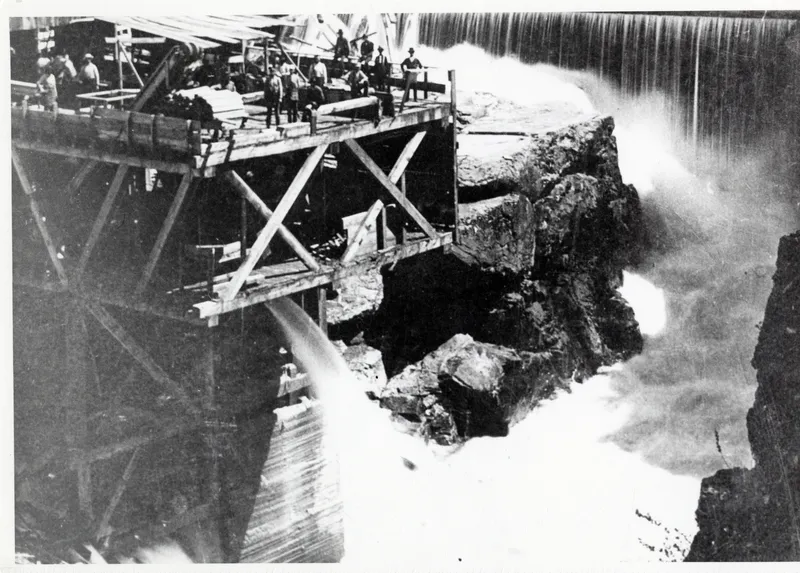
What drew him back was the shape of the river itself. Post told the paper that there was almost a natural mill race formed in the solid rock at the side of the falls, and that with blasting powder he would complete the work of nature. The sawmill was finished early in 1880, and later historians wrote that the history of Post Falls may be said to date from its completion. By later survey, the mill and the townsite stood on the northeast quarter of Section 3, Township 50, Range 5 west of the Boise meridian, on a mill site and adjoining lands that Post had purchased from the Coeur d'Alene Tribe at a time when the northern boundary of the reservation at that point was the Spokane River.
Post did not run the new mill himself for long at first, because his business interests in Spokane required his attention. The mill was leased to other parties for a number of years, first to a Mr. Lewis and later to Fred Bish, and the two of them in turn ran it until 1886, when Post himself took charge. He conducted it for about three years, and then he leased it again to Fred Bish.
The lease years ended in sorrow on the river that powered the mill. In the summer of 1892, Bish and a companion were working at a boom of logs just above the falls, in a rowboat that was tied to the logs. The fastenings broke, and the boat and its occupants went over the falls. Both lives were lost. After the accident, the mill was leased to S. D. Bader, who operated it until 1894.
In 1894, Post sold the mill to the Spokane and Idaho Lumber Company, of which H. M. Strathern was president. Even in selling, however, Post kept faith with the town that was growing up around his mill. He had put in a system of waterworks in 1885, and the distribution mains were renewed in 1892. When he sold the mill, he reserved the perpetual right to power sufficient to pump water for town use, and by the time a history of North Idaho was published in 1903, the waterworks plant belonged to his daughter, Mrs. Alice Martin. The man who came back in 1879 to finish a sawmill with blasting powder had made sure that the town at the falls would keep its water long after the mill was no longer his.