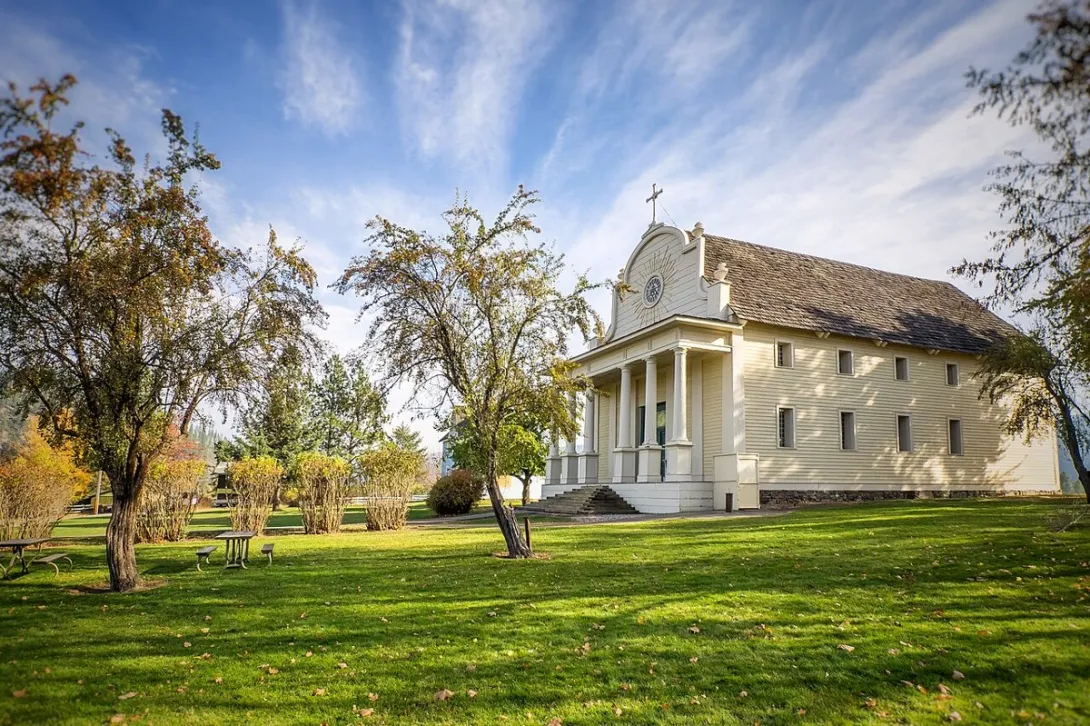
Drive east from Post Falls on Interstate 90, up the Coeur d'Alene River valley toward Cataldo, and a pale church rises on a grassy hill above the river. It does not look like a frontier improvisation. It has columns, a rounded sunburst over its front window, and the calm proportions of an Italian cathedral, and it is the oldest standing building in Idaho. What makes it remarkable is not only its age, but whose hands built it: members of the Coeur d'Alene Tribe, the Schitsu'umsh people, raised it between 1850 and 1853, long before Post Falls itself had a name.
The story began a few years earlier. In the early 1840s the Coeur d'Alene people, curious about the Jesuit missionaries they called the black robes, invited them to live among them. The first mission stood on the St. Joe River, but spring flooding forced a move, and in 1846 a new site was chosen above the Coeur d'Alene River near present-day Cataldo. There, Father Antonio Ravalli, an Italian Jesuit who had studied mathematics, science, and art, designed a permanent church for the Mission of the Sacred Heart, modeled after the cathedrals of his homeland in a simplified Baroque style.
Then came the building itself, and that is where tribal craftsmanship carried the whole enterprise. About three hundred Coeur d'Alene people worked alongside two missionaries on a church roughly ninety feet long and forty feet wide. They had almost no manufactured supplies, so they worked with broadaxes, augers, ropes and pulleys, a penknife, and a whipsaw they had made themselves. Not a single nail was used. Heavy timbers were joined with mortises and wooden pegs, willow saplings were woven between the uprights, wild grass was worked in, and river mud was spread over the whole surface, a method called wattle and daub.
The same resourcefulness filled the inside. Chandeliers were fashioned from old tin cans, hand-carved details came from local materials, and the soft blue coloring on the interior wood was not paint at all, but a stain made by pressing local huckleberries into it. When the church was completed in 1853, it became far more than a place of worship. It served as an important stop and supply station for settlers, miners, and traders traveling the Mullan Road, and as a working port for boats moving up the Coeur d'Alene River.
More than one hundred seventy years later, the church still stands on its hill. It was designated a National Historic Landmark in 1961 and added to the National Register of Historic Places in 1966, and it is also recognized as the oldest surviving mission church in the Pacific Northwest. Today it anchors Coeur d'Alene's Old Mission State Park, alongside a restored parish house, two historic cemeteries, and a visitor center, and tribal members still return for the annual pilgrimage that honors the mission. For Post Falls readers, it is a short drive and a powerful reminder that the region's first great building was built by its first people, with mud, timber, berries, and extraordinary skill.