In late 1995, the whistle blew for the last time at the sawmill on the north bank of the Spokane River in Post Falls. Louisiana-Pacific shut its saws down and 115 mill workers walked out the gate, ending a lumber era that had begun 124 years earlier, when the town's namesake first set a saw blade turning at the falls.
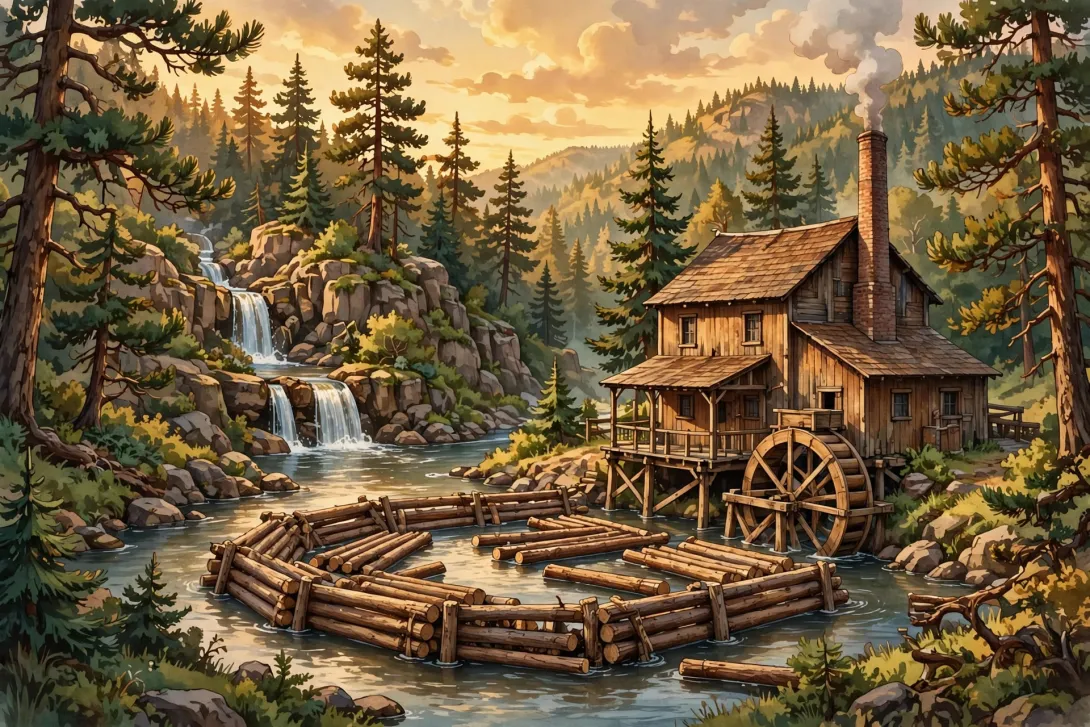
Frederick Post had come for the water power. In 1871 he took up a mill site at the falls and installed a saw and planing mill, harnessing the river's north channel with a 20-foot timber-crib dam built of layered logs. The mill burned to the ground in 1902 — the dam survived — and in 1904 the newly formed Washington Water Power bought the site, replacing the timber mill with three concrete dams and a brick powerhouse completed in 1906.
But Post Falls was never just one mill. Through the late 1800s and into the 1900s, the riverbank hummed with saws cutting the region's great white pine. Logs rode the waterways down to the mills in floating booms, and at sorting works each company's logs were picked out by their marks. As one old-timer recalled in the Forest Service's Idaho Panhandle oral history project, every log carried an end stamp and a bark mark chopped with an axe — an anchor for the Coeur d'Alene mill, a K for Winton, and the old Post Falls mill's own mark. Each mill knew its logs by sight.
The last of those riverbank mills was the Louisiana-Pacific sawmill on a 33-acre site west of Spokane Street, with some 2,000 feet of frontage on the river's north bank. When the saws went quiet in late 1995, the Spokane Journal of Business later reported, the property was listed for sale in 1997 for $6.5 million. It sat idle for years — even failing to sell at auction — before selling in 2001 for close to $1.75 million to a group that called its vision the Point at Post Falls.
Today that ground is The Landing at Post Falls, a mixed-use development on the north bank where homes, shops, and a marina have risen from the old mill yard. The whistles are silent, but stand at Falls Park and look across the water: the same current that once carried log booms to the saws still runs past the brick powerhouse Post's mill gave way to. The town's name is Post, and it has always been a mill town — it just mills memories now.