
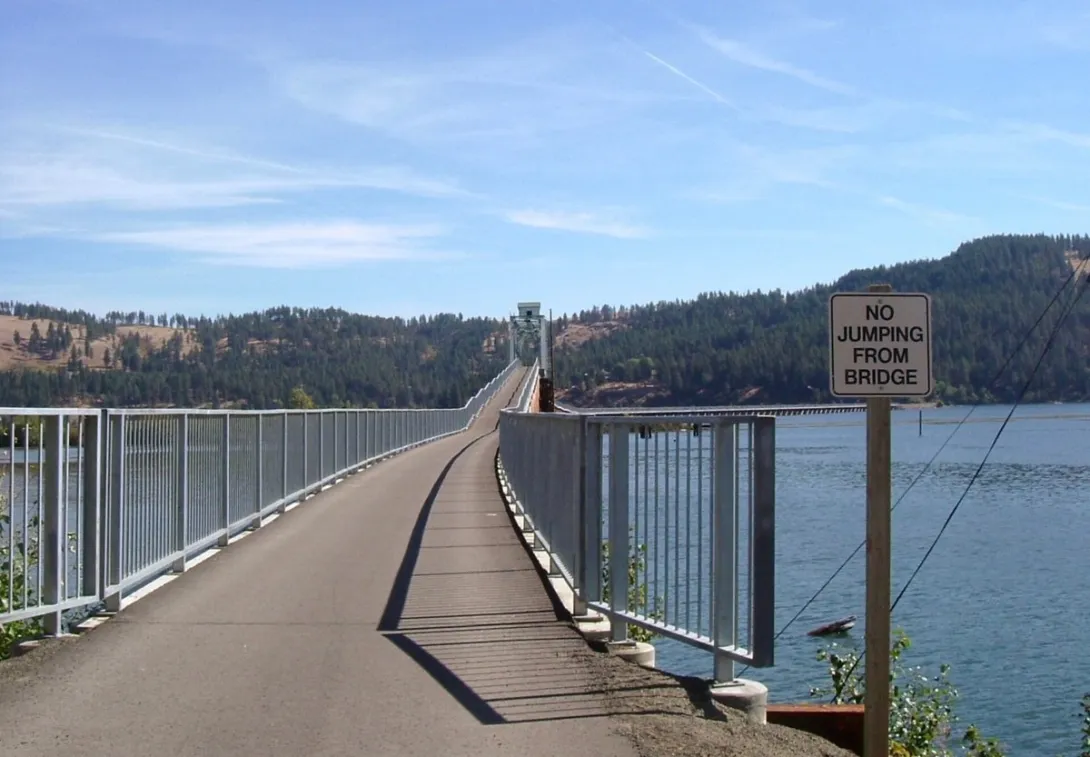
Post Falls sits on the Spokane River below Lake Coeur d'Alene, and the lake upstream was the heart of a much older homeland. The Coeur d'Alene Tribe, the Schitsu'umsh, once inhabited more than 3.5 million acres in what is now northern Idaho and northeastern Washington, including the lake and the St. Joe River. Members used the lake and its waterways for food, fiber, transportation and cultural activities, and depended on the submerged lands themselves, from water potatoes harvested from the lakebed to fish weirs anchored in the riverbeds.
That dependence explains a line drawn in 1873. After an earlier 1867 reservation failed to make adequate provision for fishing and other uses of important waterways, the Tribe insisted on a reservation that included key river valleys, saying it was not yet quite up to living on farming and still needed hunting and fishing. The 1873 agreement described a reservation covering part of the St. Joe River and all of Lake Coeur d'Alene except a sliver cut off by the northern boundary. On November 8, 1873, President Ulysses S. Grant issued an executive order setting that reservation apart. Its northern boundary ran straight across the lake instead of following the shoreline, and an 1883 survey fixed it at 598,499.85 acres, a total that necessarily included submerged lands.
By 1885 Congress had neither ratified the 1873 agreement nor compensated the Tribe, so the Tribe petitioned for confirmation. In 1887 the Tribe ceded claims to lands outside the reservation, for a promise the reservation would be held forever as Indian land. In 1889 the Tribe agreed to cede the northern portion, including about two-thirds of the lake, for 500,000 dollars. A United States negotiator reassured the Tribe it still had the St. Joseph River and the lower part of the lake. Idaho became a state on July 3, 1890, while ratification was still pending, and Congress ratified both agreements on March 3, 1891. That same act directed that a Spokane River portion be conveyed to Frederick Post, described as all three river channels and islands, with land on both shores for water power. It is ground Post Falls stands on.
A century later, the old line was tested again. The question was whether Idaho, entering the Union on an equal footing with the original states, had received title to the lakebed inside the reservation, or whether the United States had kept it in trust for the Tribe. The United States sued Idaho to quiet title as trustee for the Tribe, and both the federal district court and the Ninth Circuit ruled for the United States and the Tribe.
On June 18, 2001, the Supreme Court affirmed in Idaho v. United States. It held that the national government holds title, in trust for the Tribe, to lands underlying portions of Lake Coeur d'Alene and the St. Joe River within the current reservation, the lower third of the lake. The reasoning reached back to 1873: the executive reservation had clearly included submerged lands, and Congress had recognized it in a way that showed it intended to defeat the future state's title.
Did you know a boundary you cannot see still shapes the lake Post Falls depends on? From Q'emiln Park and Falls Park, the view upstream reaches toward water whose southern bed is held in trust for the people who were found here long before the town had a name. The line drawn across the lake in 1873 was not surveyor's ink alone. It recorded what the Tribe said it needed to live, and in 2001 the nation's highest court said that record still counted.