Long before Post Falls had a name, an Army captain and a crew of soldiers and civilian laborers hacked the first engineered road through the Idaho Panhandle — a route that would change the region forever.
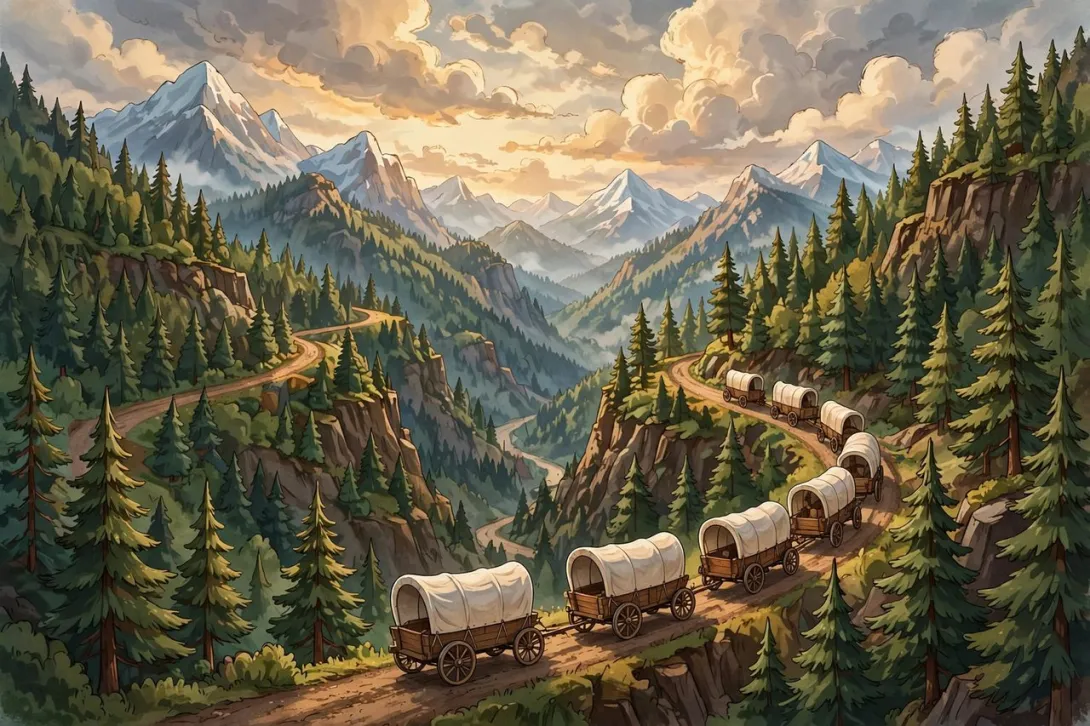
Captain John Mullan spent 1859 and 1860 building the road Congress had funded to connect Fort Walla Walla in Washington Territory to Fort Benton on the Missouri River. Backed by a series of appropriations totaling $230,000, Mullan's crew pushed through dense forest, steep grades, and harsh weather to create what is recognized as the first engineered road west of the Mississippi River.
The Idaho portion of the route was built in 1859, following the Coeur d'Alene River and its south fork — a corridor the Coeur d'Alene people had long used to reach hunting grounds in what is now Montana. From the Montana line, the road dropped through the Bitterroots, swung southwesterly across Idaho past the south end of Lake Coeur d'Alene, and crossed into Washington some distance south of Spokane before threading the Palouse and the scablands toward the Columbia.
The Mullan Road served travelers for only a few decades, but those decades mattered. It carried prospectors, settlers, and Army freight, opening the interior for the waves of settlement that followed. The route's importance faded after the Northern Pacific Railroad reached the region in 1883, but the road never entirely disappeared — stretches of Old Mullan Road survive today, including a section over Fourth of July Pass that is listed on the National Register of Historic Places.
In 1978, the American Society of Civil Engineers designated the Mullan Road a National Historic Engineering Landmark, recognizing the audacity of Mullan's project: hundreds of miles of road blasted, graded, and bridged by hand through some of the toughest terrain in the West.
North Idaho residents can still walk in Mullan's footsteps at the Captain John Mullan Museum near Cataldo, where interpretive signs tell the story of the road-building expedition and the pioneers who traveled it. Roughly a decade after Frederick Post raised his sawmill at the falls, that road was the reason anyone from the outside world could reach him at all.