Did you know the best seat in Post Falls was once a working riverbank, closed off by the business of mills and power? About nine miles west of Coeur d'Alene Lake, the Spokane River splits into three channels, each with its own natural falls, then rejoins just downstream. That tumble of water is why a town grew here at all, and for more than a century most people experienced it as industry, not as a place to linger with a picnic.
Frederick Post recognized the power in that drop early. He built a timber-crib dam about 20 feet high across the north channel to divert water to his sawmill, a dam so well built that Washington Water Power later used it as a cofferdam for its own work. After the mill burned in 1902, the company bought the site in 1904 and built dams across all three channels, with a brick powerhouse in the middle channel, the deepest and most confined of the three. The falls kept working, generating power, while the north bank stayed a place you passed, not a place you visited.
The turning point came in the early 1990s, and it came from the town itself. A citizens group in Post Falls set out to enhance recreation at the hydroelectric site and built Falls Park along the north channel of the Spokane River. Washington Water Power, known as Avista Corporation since 1999, donated 22 acres of land for the park, and its development was financed through private donations and grants. In other words, Falls Park was not simply handed to the community. Neighbors helped imagine it, fund it, and build it.
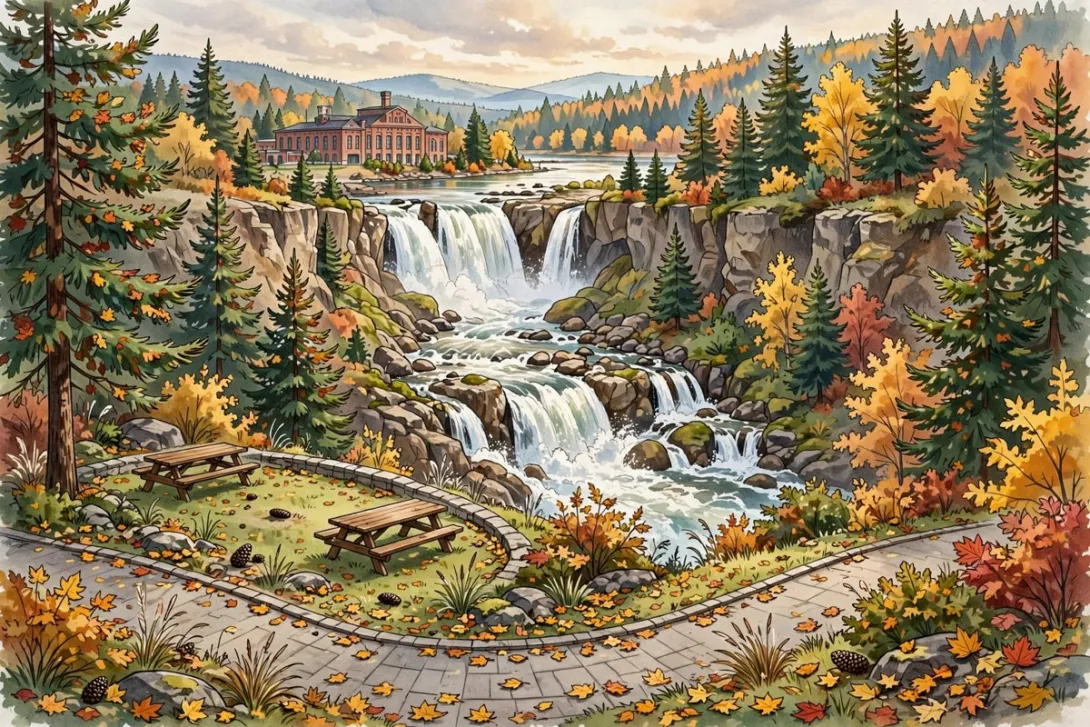
What they created turned the town's founding landscape into its front porch. The park offers picnic areas and playgrounds, scenic overlooks of the spillway and powerhouse, and wheelchair-accessible trails. Interpretive signs placed throughout the park describe the area's history and features, so a short stroll becomes a quiet lesson in how the river shaped the town, from sawmill to powerhouse. A children's fishing pond near the center of the park adds a gentler note, a calm counterpoint to the roar just beyond the overlooks.
Come in spring, when high water is moving through, and the park shows its drama. Visitors tend to drift to the far edge, where water thunders through the spillways and over the 50-foot-high natural falls into the gorge below. It is the same force that once turned mill wheels and then lit mines, mills, and railways across northern Idaho and eastern Washington, now watched simply for the wonder of it.
That is the quiet achievement of Falls Park. It did not erase the working river. It gave people a way to stand beside it, read its story on a sign, let the children play within earshot of the falls, and understand, in one view, why Post Falls is here. The river built the town. In the early 1990s, the town finally built itself a place to sit and watch the river.