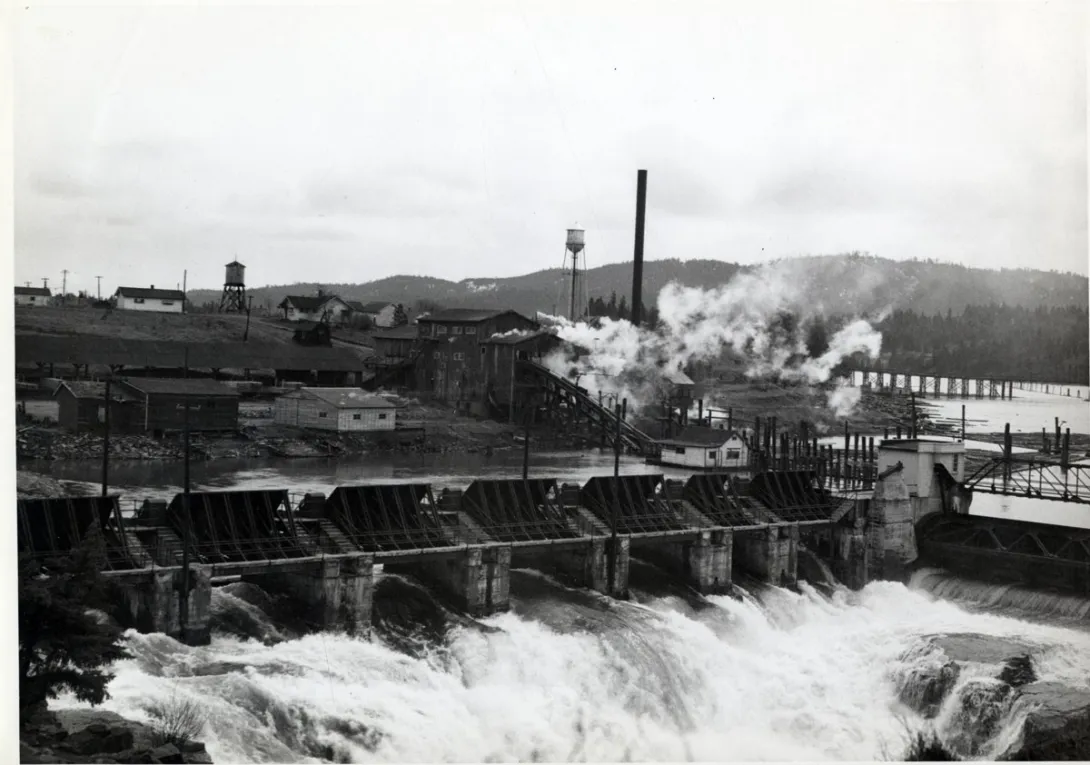
By the time Potlatch came to Post Falls in 1975, this town had already lived with sawmills for nearly a century. Mill whistles, log ponds and lumber stacks were part of everyday life here, and the black-and-white photograph above, taken in 1946, shows the Post Falls Lumber Company sawmill working above the falls on the Spokane River. The harder question for the industry by the 1970s was no longer just how to saw a log. It was what to do with everything the saw left behind.
Potlatch had been asking that question for a long time. The Potlatch Lumber Company was incorporated in 1903 by Frederick Weyerhaeuser and other investors, and its first sawmill, built in 1906 at the town of Potlatch, Idaho, was the largest white pine mill in the world. After the Depression-era merger that created Potlatch Forests, Inc. in 1931, the company made a point of using more of every tree. In the early 1930s its researcher Robert Bowling invented a commercial use for sawdust, the Pres-to-log fireplace log, and in 1950 Potlatch started its first pulp and paperboard mill, turning sawmill waste into bleached pulp for packaging paperboard.
Post Falls was the next step in that same idea. Two years after Potlatch Forests became Potlatch Corporation in 1973, reflecting its diversification and expansion, the company built a particleboard plant here in 1975. Potlatch's own history describes it plainly, and proudly: the plant was built, in the company's words, continuing its tradition of complete wood utilization, to use dry sawdust, chips and shavings from the region's many sawmills and plywood plants. Material that mills once burned or piled as waste arrived in Post Falls and left as a useful panel product.
The plant became a steady part of the regional mill network. In the late 1990s, Potlatch still operated it alongside its plywood plant and lumber mill in St. Maries, another plywood plant near Pierce, and its large Lewiston complex, employing about 3,000 people across Idaho. A Potlatch archive even preserves a color aerial photograph labeled Post Falls Particleboard, taken in November 1997, and a company videotape of the plant from 1999.
Like every mill town, Post Falls also felt the bust that followed the boom. In November 2008, with the wood products market at what a company spokesman called a 25-year low, the Post Falls particleboard plant, then employing 35 people, was already closed and was to stay closed until orders increased. By June 2009, however, Potlatch had reopened it and was running two shifts. At least for now, a company official told the Spokane Journal of Business, the market was allowing it to operate.
That little plant tells a bigger Post Falls story. The lumber era here did not end when the big logs grew scarcer. It changed, from Frederick Post's first water-powered sawmill, to the busy mills photographed at the falls, to a factory whose whole purpose was to make something valuable out of sawdust, chips and shavings. In Post Falls, even what the sawmills threw away got a second life.