Did you know that one of the first highways to cross the entire United States ran right through Post Falls? Long before Interstate 90 carried travelers across North Idaho, the Yellowstone Trail brought the first generation of automobile tourists through town, following a route so well chosen that every major road since has used nearly the same ground.
The trail began with an ambitious idea. In 1912, J. W. Parmley of Ipswich, South Dakota, set out to build a good road between two towns twenty-five miles apart, and the vision kept growing until it stretched, in the words of its famous motto, from Plymouth Rock to Puget Sound. The Yellowstone Trail Association, founded that same year and headquartered in Minneapolis, did not build roads itself. Instead, it helped local chapters raise money, shared standards for construction and maintenance, printed maps and pamphlets, and promoted the brand-new idea of long-distance automobile tourism. It became one of the great successes of the Good Roads Movement, and by 1920 it was one of only two transcontinental named highways in the country.
North Idaho built its section between 1914 and 1916. Kootenai County notes that the trail was cut into the hillside above today's Interstate 90, followed much of the same route as the Mullan Road, and used ground that Plateau peoples had traveled for generations on their way to the Great Plains. Coming west from Montana, motorists passed through Mullan, Wallace, Kellogg, and Cataldo, descended through Fourth of July Canyon, and rolled through Coeur d'Alene and Post Falls before crossing into Washington.
In 1926, the named trail received a number. The Yellowstone Trail became U.S. Highway 10, a route of more than two thousand miles from Detroit to Seattle that was also known at different times as the Sunset Highway, the North Pacific Highway, and the Appleway. Through Post Falls, that highway is still familiar ground: Seltice Way follows the old U.S. 10 alignment. Along the route, motels, auto courts, cafes, and root beer stands sprang up to serve travelers, and a drive across the country became an ordinary American adventure rather than an expedition.
The interstate era arrived in stages. Interstate 90 was created by the federal government in 1957, generally following the route of U.S. 10 and the old Mullan Road, and the freeway was built piece by piece over the following decades. The link from Post Falls to the Washington state line was completed in 1972, upgrading the existing road and adding a new bridge over the Spokane River. As traffic shifted to the freeway in the late 1960s and 1970s, many of the old highway businesses along U.S. 10 faded, while Post Falls found itself on the main east-west artery of the northern United States.
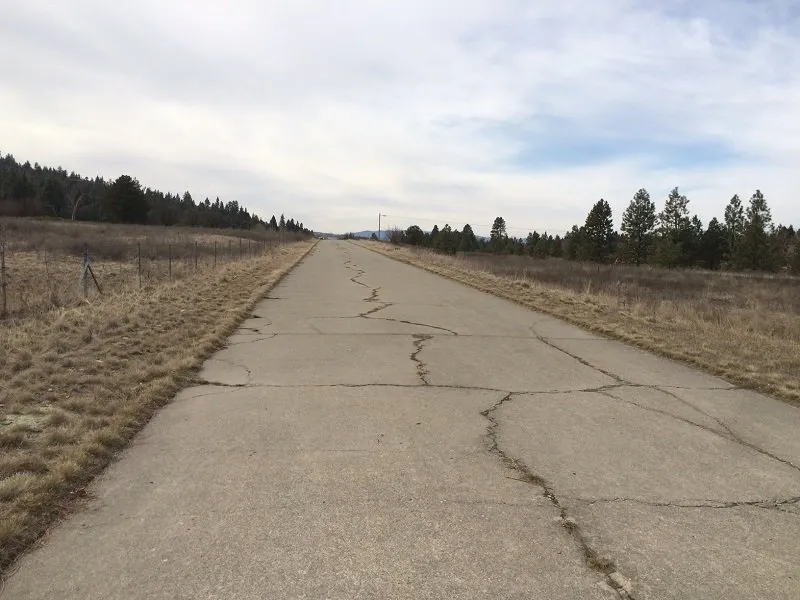
The loveliest part of the story is that you can still walk the original. A surviving strip of the old U.S. 10 pavement at the Idaho and Washington border is now part of the North Idaho Centennial Trail, traveled on foot and by bicycle rather than by Model T. Look closely as you go and you can find dates stamped into the concrete about every hundred feet, marking when each section was poured; one reads July 23, 1920. It is a quiet, cracked, and wonderful monument to the road that first put Post Falls on the map for the automobile age.