
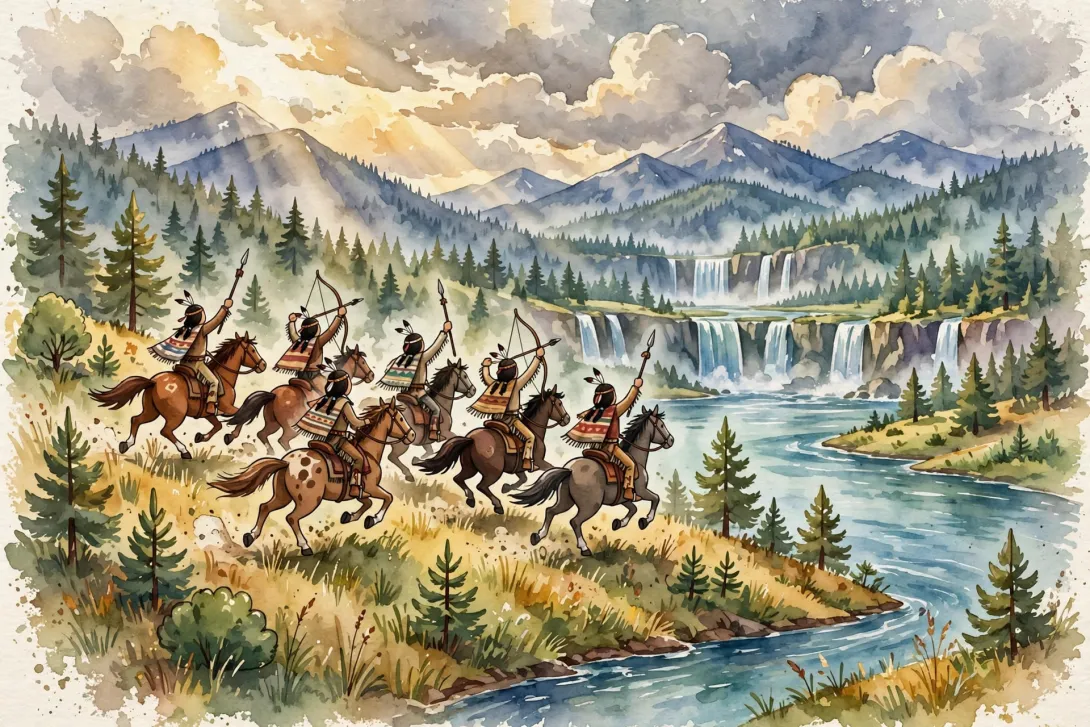
Thirteen years before Frederick Post built his mill, this land was a war zone. The falls where Post Falls now stands sat within the homeland of the Schitsu'umsh — "the ones who were found here" — the Coeur d'Alene people who fished the Spokane River and speared salmon at the rapids that still carry their old name, Q'emiln, the throat of the river. Their lands were protected by treaty, but by 1858 miners were trespassing on tribal territory, and the Army was surveying the Mullan Road through it, which the Schitsu'umsh read plainly as a land grab. When two white miners were killed, the Army decided to retaliate — and the Coeur d'Alene War began.
On May 17, 1858, the warriors struck first. A combined force of roughly a thousand Coeur d'Alene, Spokane, Palouse, Yakama, and Cayuse fighters under Chief Kamiakin surrounded a column of 164 soldiers under Lieutenant Colonel Edward Steptoe at Pine Creek, near present-day Rosalia, Washington. For ten hours the running battle raged until the soldiers dug in on a hill and, in darkness and drizzling rain, slipped away. Their defeat was so complete that, as descendants of the warriors tell it, the chiefs simply let them go.
Washington's answer was Colonel George Wright, who marched north with more than 500 soldiers, civilian drovers, and 30 Nez Perce scouts — and a decisive new advantage: long rifles that could reach a thousand yards, many times the range of the warriors' muskets and bows, backed by howitzers and field guns. On September 1, 1858, at the Battle of Four Lakes, Wright's line opened fire from what the warriors believed was safe distance, then charged. The resistance broke. Four days later, at the Battle of Spokane Plains, the allied tribes fell again.
What followed was punishment meant to be remembered. Wright ordered seventeen men hanged along Latah Creek — still called Hangman Creek in Idaho to this day — among them Qualchan, a Yakama chief. Soldiers slaughtered the tribes' horse herds and burned their villages and winter food stores. Broken by the campaign, the tribes were brought to council and forced toward reservations, and the Mullan Road pushed through within the decade. The miners and settlers who flooded the region after the war found a world the fighting had cleared — the world Frederick Post walked into in 1871.
The Schitsu'umsh endured. They still live in the region, and their story is still sung and danced. When you stand at the falls or walk the river trail, you are standing in the homeland of "the ones who were found here" — and 1858 is part of why this town exists and why it looks the way it does. The war came before the town, and the town has never been the same since.