Skip to header Skip to main navigation Skip to main content Skip to footer
Home
Post Falls Idaho
Where Nature Welcomes You Home

Main navigation

  • Home
  • Dining
  • Lodging
  • Shopping
  • Things to Do
  • Outdoors
  • History
  • Business Directory
  • Webcams
  • 7-Day Weather Forecast (opens in new tab)

Idaho History

The Park the River Built: How Falls Park Gave Post Falls Its Front Porch
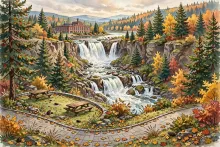
Cartoon illustration of Falls Park in Post Falls, with picnic tables and autumn trees overlooking the Spokane River falls and the historic brick powerhouse

Did you know the best seat in Post Falls was once a working riverbank, closed off by the business of mills and power? About nine miles west of Coeur d'Alene Lake, the Spokane River splits into three channels, each with its own natural falls, then rejoins just downstream. That tumble of water is why a town grew here at all, and for more than a century most people experienced it as industry, not as a place to linger with a picnic.
  • Read more about The Park the River Built: How Falls Park Gave Post Falls Its Front Porch

From the Tracks to Spokane Street: How Downtown Post Falls Found Its Center

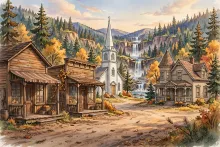
Cartoon illustration of an early Post Falls downtown street with wooden storefronts, a white church with a tall steeple, a Queen Anne house, pine trees and falls in the distance

Did you know Post Falls did not start with a tidy downtown at all? When the town incorporated in 1891, its first shops stood in blocks platted on either side of the railroad tracks, with modest homes in the blocks to the north and south. Maps from the era show plenty of empty space between buildings, so early downtown was less a solid row of storefronts than a hopeful scatter of businesses, houses, and vacant lots waiting for a town to grow up around them.

  • Read more about From the Tracks to Spokane Street: How Downtown Post Falls Found Its Center

Last Call for 2026: Post Falls History Museum Closes Oct. 31

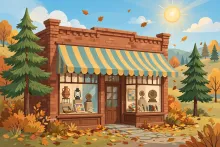
Cartoon of a small-town history museum in a 1920s brick storefront building.

October is your last call. The Post Falls Historical Society Museum, at 101 E. 4th Ave. on the City Hall campus, closes to the public for the season on Oct. 31 — and October is your final chance to wander its rooms until spring.

The museum lives in the historic Chapin Building — Chapin's Drugs, built in 1923 — and admission is free. Inside, the volunteer-run museum traces Post Falls from frontier town to fast-growing prairie city, with artifacts, photographs, and displays drawn from the society's collections.

  • Read more about Last Call for 2026: Post Falls History Museum Closes Oct. 31

When Steam Ruled the Lake: Lake Coeur d'Alene's Steamboat Era

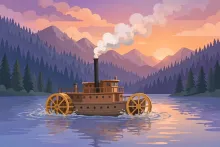
Cartoon of a side-wheeled steamboat crossing a mountain lake at sunset.

Long before highways stitched North Idaho together, Lake Coeur d'Alene ran on steam. In the late 1800s and early 1900s, more than 50 steamboats worked the lake and its rivers, hauling logs and ore, carrying passengers and mail, and turning the water into the region's first highway system.

  • Read more about When Steam Ruled the Lake: Lake Coeur d'Alene's Steamboat Era

The Old Church That Refused to Become a Parking Lot

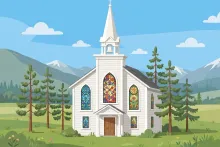
Cartoon of a white historic church with steeple and stained-glass windows in Post Falls.

At the corner of Fourth Avenue and William Street in Post Falls stands a white church that nearly became a parking lot. Instead, it became the town's living room for the arts. The Jacklin Arts & Cultural Center, at 405 N. William St., is two 1890s churches with one extraordinary second act.

  • Read more about The Old Church That Refused to Become a Parking Lot

Electric Cars and Iron Rails: How Post Falls Rode the Interurban Age

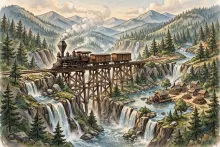
A cartoon watercolor illustration of an 1880s steam locomotive crossing a wooden trestle over river falls beside a frontier lumber mill settlement.

When the Northern Pacific built its transcontinental line through the Idaho Panhandle in 1881 and 1882, the iron road simply went around Post Falls. Growth followed the rails north to Rathdrum, and the little mill town by the falls went quiet. Relief came in 1886, when Daniel Chase Corbin built the Spokane Falls & Idaho Railroad, a branch about 13.5 miles long connecting the Northern Pacific at Hauser Junction — named for Corbin’s friend and business partner — with Post Falls and Coeur d’Alene.

  • Read more about Electric Cars and Iron Rails: How Post Falls Rode the Interurban Age

The War Before the Town: 1858 and the Schitsu'umsh Fight for Their Homeland

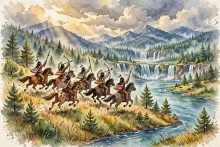
Watercolor cartoon illustration of Schitsu'umsh horsemen riding beside a river with waterfalls, evoking the 1858 battles in their homeland

Thirteen years before Frederick Post built his mill, this land was a war zone. The falls where Post Falls now stands sat within the homeland of the Schitsu'umsh — "the ones who were found here" — the Coeur d'Alene people who fished the Spokane River and speared salmon at the rapids that still carry their old name, Q'emiln, the throat of the river. Their lands were protected by treaty, but by 1858 miners were trespassing on tribal territory, and the Army was surveying the Mullan Road through it, which the Schitsu'umsh read plainly as a land grab.

  • Read more about The War Before the Town: 1858 and the Schitsu'umsh Fight for Their Homeland

The Mullan Road: The 1859 Highway That Opened the Idaho Panhandle

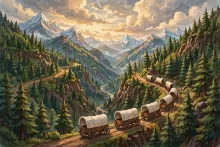
Cartoon illustration of covered wagons winding along a dirt mountain road through dense pine forest in a steep valley.

Long before Post Falls had a name, an Army captain and a crew of soldiers and civilian laborers hacked the first engineered road through the Idaho Panhandle — a route that would change the region forever.

  • Read more about The Mullan Road: The 1859 Highway That Opened the Idaho Panhandle

Iron on the Prairie: The Railroads That Reached the Lake in 1886

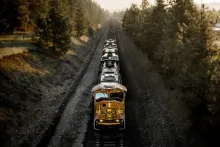
A BNSF freight train traveling on tracks through the pine forests of the Rathdrum Prairie in North Idaho.

Getting to Post Falls in 1885 meant a stagecoach over dirt roads. Within a year, it meant the iron horse — and the transformation of the Rathdrum Prairie happened fast.

  • Read more about Iron on the Prairie: The Railroads That Reached the Lake in 1886

Treaty Rock: The Legend Written on Post Falls' Most Famous Stone

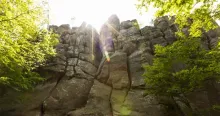
Treaty Rock Park in Post Falls, a tall rock formation surrounded by green trees in sunlight.

At the end of a short, easy trail in the middle of Post Falls sits one of the most storied rocks in North Idaho — a massive granite boulder that gave Treaty Rock Park its name.

  • Read more about Treaty Rock: The Legend Written on Post Falls' Most Famous Stone

Pagination

  • Previous page ‹‹
  • Page 4
  • Next page ››
Subscribe to Idaho History

Copyright © 2026 Rocky Mountain Madman LLC - All rights reserved

Developed and Designed by Rocky Mountain Madman LLC