Skip to header Skip to main navigation Skip to main content Skip to footer
Home
Post Falls Idaho
Where Nature Welcomes You Home

Main navigation

  • Home
  • Dining
  • Lodging
  • Shopping
  • Things to Do
  • Outdoors
  • History
  • Business Directory
  • Webcams
  • 7-Day Weather Forecast (opens in new tab)

Idaho History

A Hundred Miles on a Wire: How Post Falls Lit the Silver Valley Mines

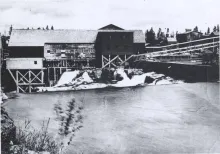
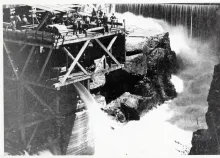
Did you know the brick powerhouse at Post Falls was not built mainly to light the little mill town beside it? When Washington Water Power finished the plant in 1906, its most important customers were hard-rock mines nearly 100 miles away in the Silver Valley. The electricity generated at the falls would travel to those mines on a high-voltage transmission line billed at the time as the longest in the world.
  • Read more about A Hundred Miles on a Wire: How Post Falls Lit the Silver Valley Mines

The Night the Mill Burned: How the 1902 Fire Halved Post Falls in Two Months

The Idaho Lumber and Manufacturing Company sawmill above the falls on the Spokane River in Post Falls, in a black and white photograph from about 1900.

Did you know that a single winter fire once cut the population of Post Falls by nearly half in just two months? On December 30, 1902, fire destroyed the mill plant of the Idaho Lumber and Manufacturing Company, the business that stood at the very center of this young town. The Illustrated History of North Idaho, published the following year, called Frederick Post's mill "the life of the town," and the weeks after the fire showed just how true those words were.

  • Read more about The Night the Mill Burned: How the 1902 Fire Halved Post Falls in Two Months

Blasting Powder and a Natural Mill Race: Frederick Post Returns to Finish His Sawmill

Frederick Post's first water-powered sawmill and its employees above the falls on the Spokane River at Post Falls, photographed about 1890.

On Christmas Day in 1879, readers of the Spokane Times learned that Frederick Post was on his way back to the Upper Falls. Post, who owned the grist mill at Spokane Falls, had left the previous Tuesday for his old place on the Spokane River, eight years after he first located there in 1871 and began building a sawmill. He had the machinery for both a grist mill and a sawmill, the paper reported, but he had given up for a time, moved the grist mill machinery to Spokane, and left the sawmill only partly finished. Now he was returning to complete it.

  • Read more about Blasting Powder and a Natural Mill Race: Frederick Post Returns to Finish His Sawmill

From a Health Park to a Hospital Campus: Kootenai Health Grows With Post Falls

Did you know that one of the clearest signs of how much Post Falls has grown is not a subdivision or a shopping center, but a doctor's office that kept getting bigger? Kootenai Health says it began serving the Post Falls community in 1996, when the city was still a small town between Spokane and Coeur d'Alene. Its presence took physical shape the following year with the opening of the Post Falls Health Park, a modest clinic campus on East Mullan Avenue that gave local families a place to see a doctor without driving to another city.

  • Read more about From a Health Park to a Hospital Campus: Kootenai Health Grows With Post Falls

Throat of the River: How Q'emiln Park Grew Into a 500-Acre Forest

South of the Spokane River, at the end of the Spokane Street Bridge, Post Falls keeps a park whose name tells you exactly where you are. Q'emiln, pronounced ka-mee-lin, is a Coeur d'Alene Salish name meaning throat of the river, for the place where the river narrows at the falls. Local historian Kim Brown found the name while researching the area for the Post Falls Historical Society, which was formally established in 1988. She submitted it to the city's naming contest, and Q'emiln Park was dedicated in 1989.

  • Read more about Throat of the River: How Q'emiln Park Grew Into a 500-Acre Forest

Sixty-Five Rooms in a Town of Six Hundred: The Hotel Mount Vernon Boom

Did you know that one of the largest hotels in Idaho once stood in a mill town of only about six hundred people? The Hotel Mount Vernon was completed in Post Falls in 1890. It rose three stories high, it contained sixty-five rooms, and it was said at the time to be one of the largest hotels in the state. A surviving photograph shows a Grand Army of the Republic convention group posed proudly in front of the building, a sign that the hotel was not only a place to sleep, but also a gathering place for the young town.

  • Read more about Sixty-Five Rooms in a Town of Six Hundred: The Hotel Mount Vernon Boom

Built Without a Single Nail: The Coeur d'Alene Hands That Raised Idaho's Oldest Building

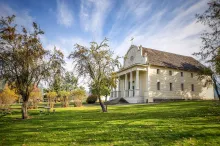
The Cataldo Mission, the Mission of the Sacred Heart, stands on a grassy hill in Old Mission State Park, its columned front and sunburst window above a green lawn.

Drive east from Post Falls on Interstate 90, up the Coeur d'Alene River valley toward Cataldo, and a pale church rises on a grassy hill above the river. It does not look like a frontier improvisation. It has columns, a rounded sunburst over its front window, and the calm proportions of an Italian cathedral, and it is the oldest standing building in Idaho. What makes it remarkable is not only its age, but whose hands built it: members of the Coeur d'Alene Tribe, the Schitsu'umsh people, raised it between 1850 and 1853, long before Post Falls itself had a name.

  • Read more about Built Without a Single Nail: The Coeur d'Alene Hands That Raised Idaho's Oldest Building

From Plymouth Rock to Post Falls: The Yellowstone Trail Became U.S. 10, Then I-90

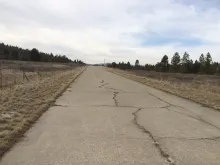
A surviving strip of original U.S. Highway 10 concrete pavement at the Idaho and Washington state line, now part of the North Idaho Centennial Trail.

Did you know that one of the first highways to cross the entire United States ran right through Post Falls? Long before Interstate 90 carried travelers across North Idaho, the Yellowstone Trail brought the first generation of automobile tourists through town, following a route so well chosen that every major road since has used nearly the same ground.

  • Read more about From Plymouth Rock to Post Falls: The Yellowstone Trail Became U.S. 10, Then I-90

Nine New Gates for a 1906 Dam: The North Channel Gets Its First Major Rebuild

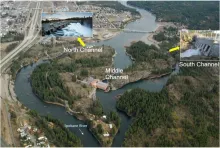
Aerial view of the Post Falls Hydroelectric Development showing the Spokane River's north, middle, and south channels and the brick powerhouse.

Did you know that the dam you can see from Falls Park is in the middle of its first major rebuild in nearly fifty years? Avista's Post Falls Hydroelectric Development has stood on the Spokane River since 1906, nine miles downstream from Coeur d'Alene Lake, where the river splits into three channels around rocky islands. The middle channel powerhouse houses six generating units that produce up to 15 megawatts of clean energy, enough to power about 11,250 homes.

  • Read more about Nine New Gates for a 1906 Dam: The North Channel Gets Its First Major Rebuild

The Plant That Used What the Sawmills Threw Away: Potlatch in Post Falls, 1975

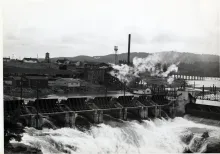
Black-and-white 1946 photograph of the Post Falls Lumber Company sawmill above the dam and falls on the Spokane River in Post Falls, Idaho.

By the time Potlatch came to Post Falls in 1975, this town had already lived with sawmills for nearly a century. Mill whistles, log ponds and lumber stacks were part of everyday life here, and the black-and-white photograph above, taken in 1946, shows the Post Falls Lumber Company sawmill working above the falls on the Spokane River. The harder question for the industry by the 1970s was no longer just how to saw a log. It was what to do with everything the saw left behind.

  • Read more about The Plant That Used What the Sawmills Threw Away: Potlatch in Post Falls, 1975

Pagination

  • Previous page ‹‹
  • Page 2
  • Next page ››
Subscribe to Idaho History

Copyright © 2026 Rocky Mountain Madman LLC - All rights reserved

Developed and Designed by Rocky Mountain Madman LLC